- Fintech
- Telegram Mini App
- Exchange
- White-label
TEX: A White-Label Telegram Exchange Platform, Live on Real Traffic
TEX is our Telegram Mini App platform for currency exchange offices — client bot, 30-second verification, relay chat, rate engine, dashboard and referrals. Launch in 3–4 weeks.
- Client
- Rippa Digital product
- Service
- Telegram Mini App Platform
- Year
- 2026
The problem TEX solves
A currency exchange office crosses about fifty orders a day and stops fitting in a group chat. Requests arrive in Telegram, other messengers and Instagram at once. A manager scrolls to find who asked for what. Rates get quoted from memory. Around five percent of orders quietly go missing — not refused, just lost between a chat and a spreadsheet.
The alternatives are worse than the problem. Custom development runs $35,000 and up over three to six months. A freelancer builds a bot and disappears. Web-first exchange platforms bolt a Telegram bot on afterwards, and it shows.
TEX is the third option: a finished Telegram-native stack, deployed under the operator's own brand, running in three to four weeks.
What it is
Six components, sold together or à la carte.
Client bot. Order intake with statuses, full history, and read receipts. A deal starts in a conversation, not in a form.
Relay chat. The manager and the client talk inside the bot, with the whole thread preserved against the order. This is the piece no competing Telegram exchange bot has, and the one operators notice first.
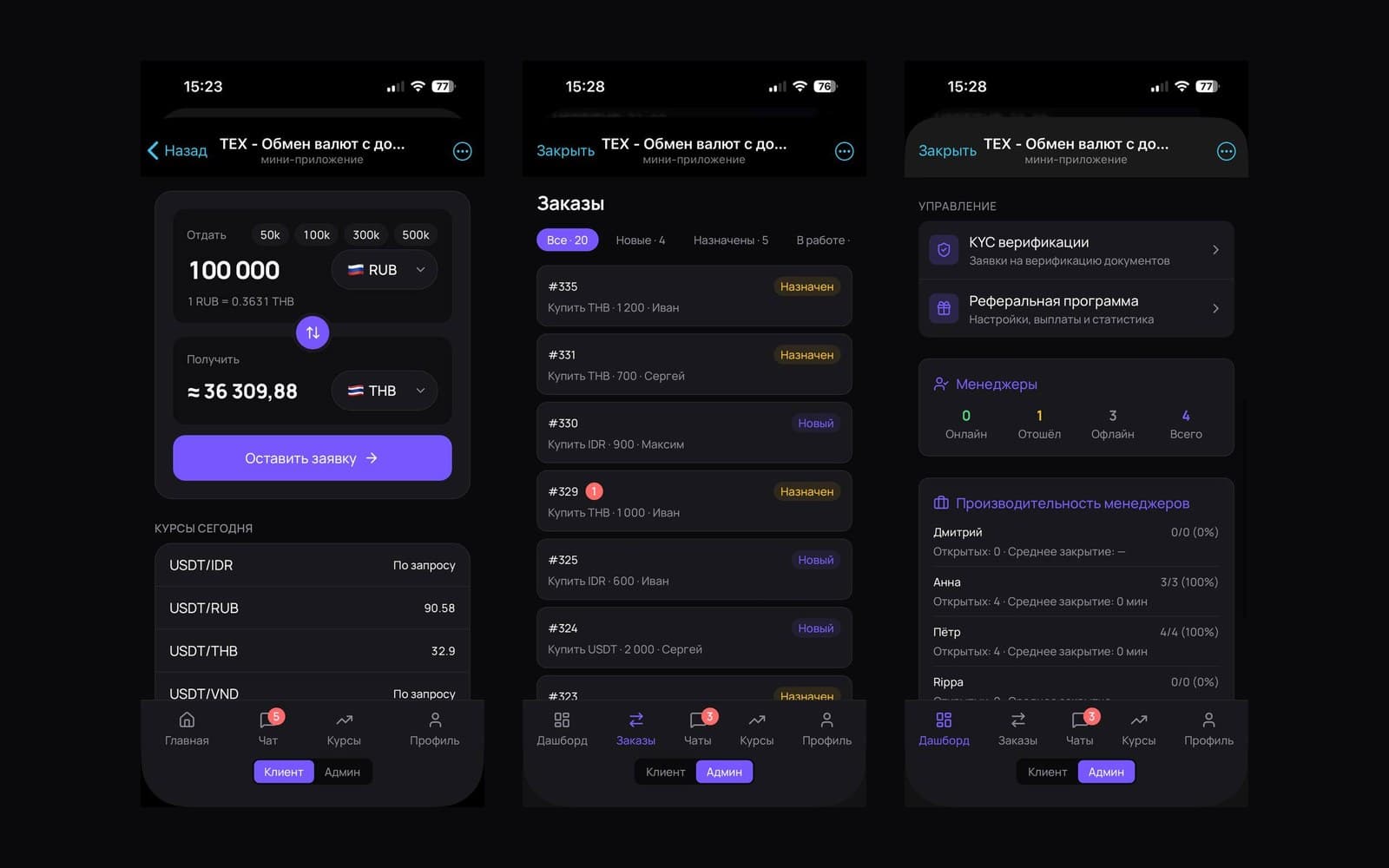
Mini App. Two cabinets in one app — the client picks a pair and leaves a request in a single tap; staff get the queue, chat oversight, close-with-figures and roles. Same design system, opposite densities: air for clients, density for a manager on their four-hundredth order.
Verification bot. KYC by Telegram contact or phone in about thirty seconds, with a second level for a document selfie. No screenshots, no manual back and forth.
Bot-ranking. A live USDT rate aggregated from five P2P sources — Bybit P2P, Rapira, Bitkub, Pintu and Indodax — plus markup, reverse calculation and one-tap copy. What took a manager two to three minutes takes five seconds.
Dashboard, referrals and site. Orders, volumes and per-manager performance in real time; a referral programme with anti-fraud, tiers and payouts; and a Next.js marketing site.
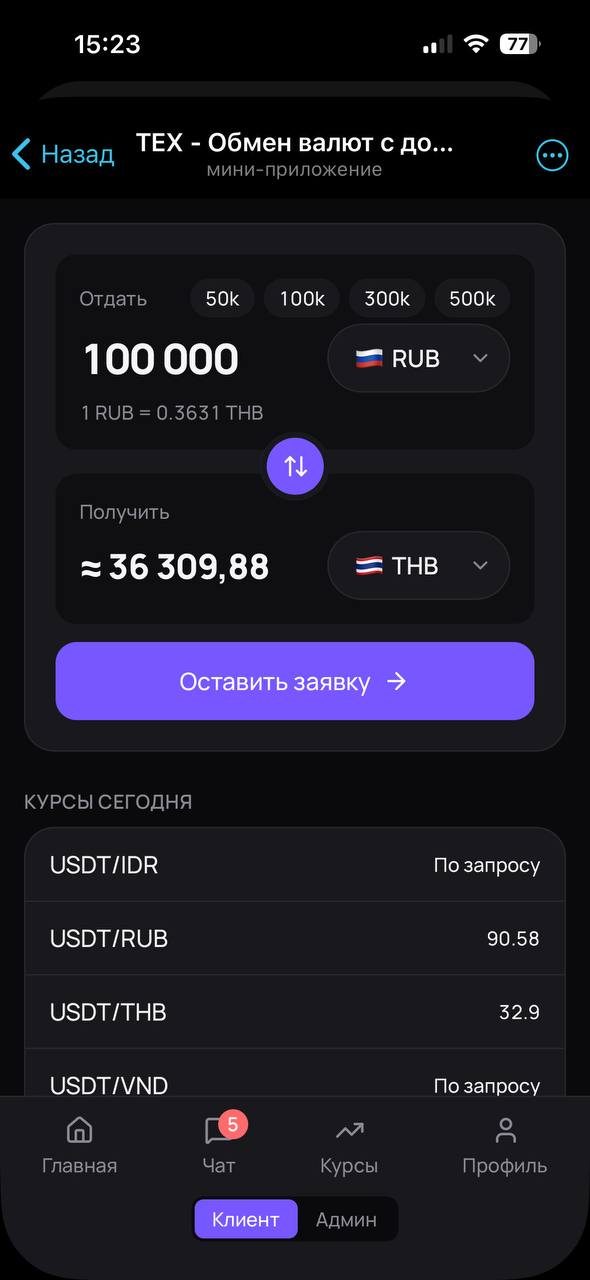
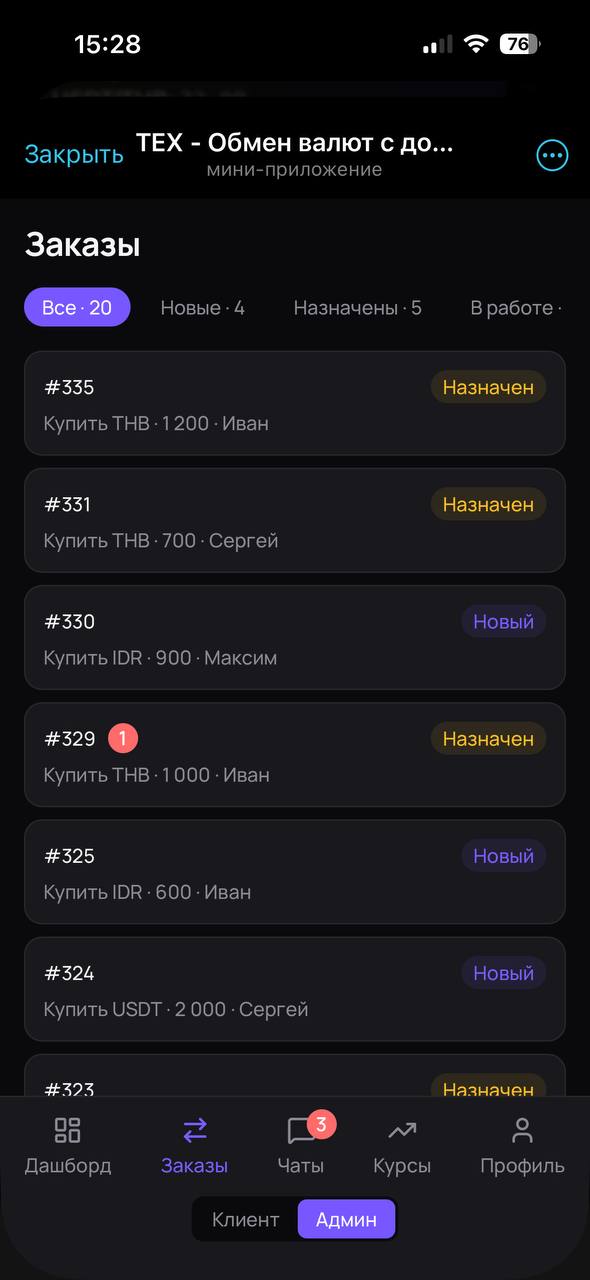
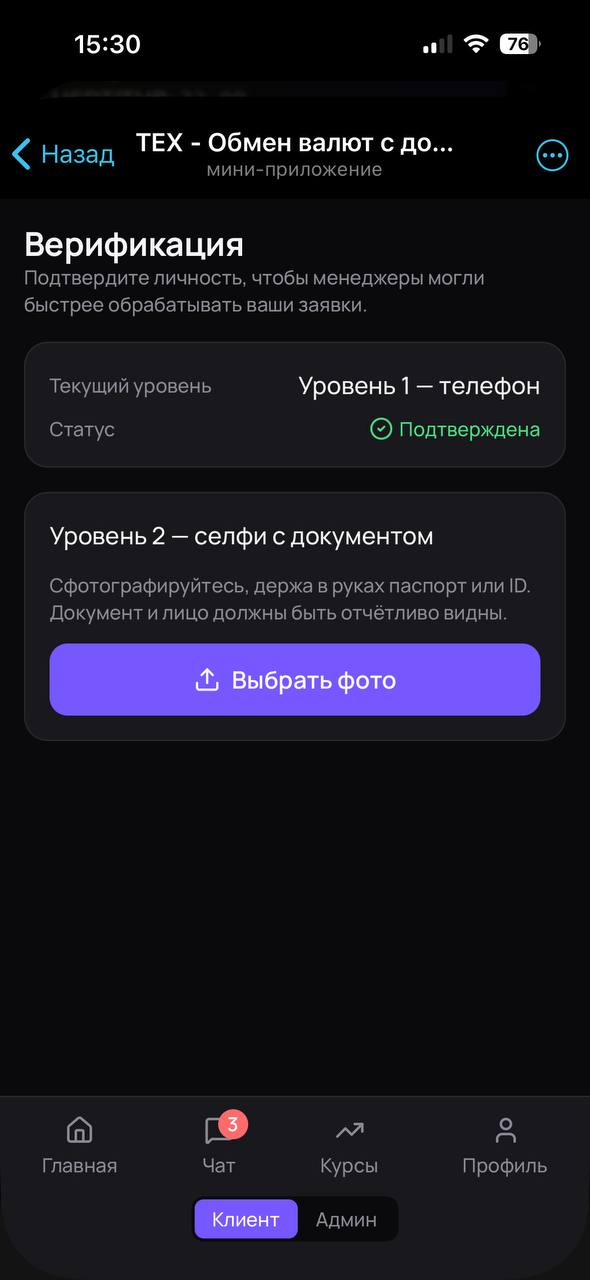
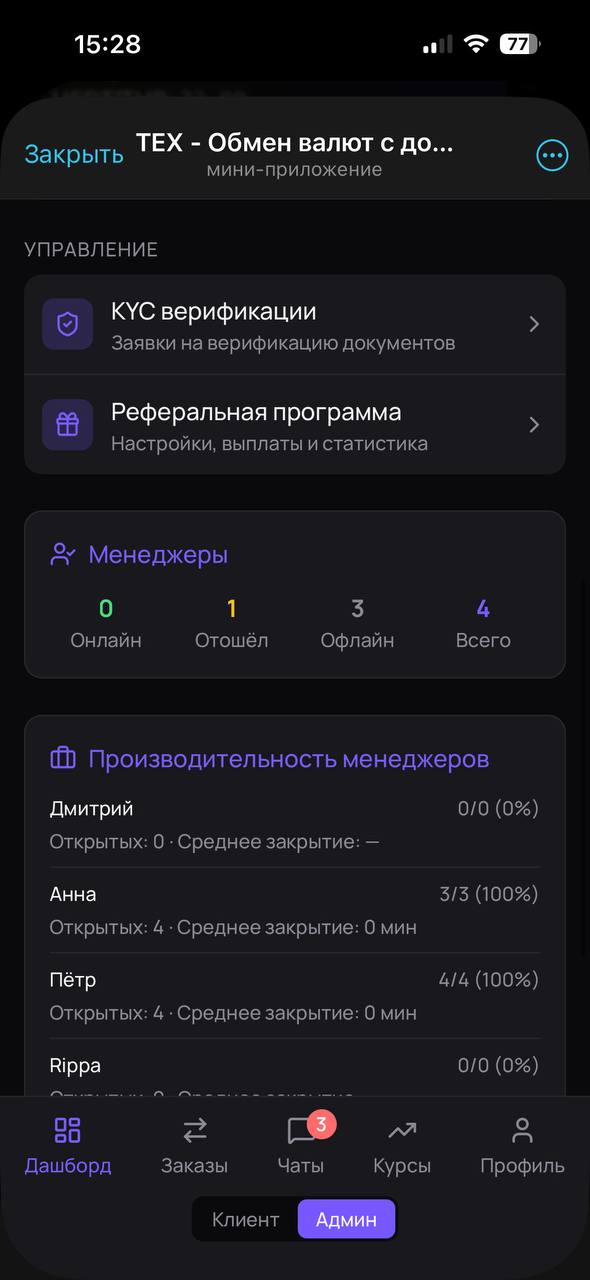
The same Mini App serves both cabinets. Interface language is set per deployment; the screenshots are from a Russian-speaking instance.
The design decision that surprises people
TEX does not publish a rate by default.
Every pair can run in one of three modes — automatic, manual, or on request — and the pilot deliberately runs the important pairs on request. A displayed figure gets read as a firm quote, and when the market moves between the display and the deal, that becomes a dispute. So the app degrades to a dash and a sentence naming the manager who will quote it.
That is a product decision, not a missing feature, and it comes from watching a real exchange operate. Bot, Mini App and website all read the rate from one source, so an operator changes the policy once.
What it changed on live traffic
The platform has been in production since spring 2026 at an exchange in Bali running 50–150 orders a day, serving Bali, Thailand and Vietnam. These are that deployment's numbers, before and after.
| Before | After | |
|---|---|---|
| Handling an order | 10–15 min | 2–3 min |
| Lost orders | ~5% | 0% (outbox pattern) |
| Verifying a client | 5–10 min | 30 sec |
| Calculating a rate | 2–3 min | 5 sec |
| Onboarding a manager | 2–3 days | 30 min |
| Analytics | by hand | real-time dashboard |
Two more numbers matter for anyone buying rather than admiring: an instance launches in three to four weeks, and deploying a new client on the existing stack takes about thirty minutes.
The product is corrected against that operation rather than against our own hypotheses. After an end-to-end test with the client's manager on the production instance in July 2026, a round of fixes shipped inside a week — message delivery, read receipts, and unblocking order closure with KYC.
How it is delivered
White-label, single-tenant: your brand, your domain, your bots, your isolated database.
Rent, hosted by us, priced by team size rather than turnover — $149, $299 or $599 a month, with branding and setup included and no setup fee. Buyout at $6,900 with source code licensed to one domain and twelve months of support. You can move from rent to buyout at any time, and the last six months of subscription are credited against the price.
Renting does not mean lock-in: data export, an open stack and source escrow all cut the other way.
Tech stack
NestJS · PostgreSQL · Aiogram 3 · React · Next.js · Docker · Redis · Twenty CRM
Who it is not for
Below roughly fifteen orders a day the pain is real but the arithmetic is not — a group chat still works and $149 a month is hard to justify to yourself. Above a few hundred a day with unusual compliance requirements, you are into Enterprise scope and custom work rather than a tier.
And if you want a fully published live rate board with automated pricing on every pair, that is a scoped add-on, not the default. The default is deliberately the other way.